

9 Secrets To Learning The Cook Islands Language
In this article, I want to share my journey of learning the Cook Islands language in three, then three more, and, another three months, give or take. I am a New Zealand-born individual from Mangere South Auckland, who embarked on this adventure at 59 years of age. Despite being an English speaker all my life, I embarked on this pursuit of self-identity. If you can relate to my story, that's fantastic. By documenting my experience, I hope to offer insights that can assist you in your own language-learning journey.
(Note: if you want to skip the long version, go to the P.S. at the bottom.) Come back when you have time.
Lets dive in.
Secret #1 - Mindset "All Things Are Possible...To Those Who Believe" (Mark 9:23)
Many believe that language learning is in your genes or not. It's a luck-of-the-draw situation, right? I used to think that way too, but I've learned otherwise. After a year of dedicated effort, I'm proof that you can tip the scales in your favour. The biggest factor is your belief. If you believe you can do it, you will. If you believe you can't, then you won't. No strategy, tactic, or secret can overcome self-defeating beliefs. If a person from Mangere, South Auckland, like me, can do this, so can you. It's not as difficult as it seems. You just need a good strategy, easy-to-do tactics and a good coach who knows how to get you "wins".
Learning a new language is like riding a bike for the first time—you'll fall, get up, regain your balance, and keep going. Just as in life on the south side, you must keep getting up and moving forward. Put in the effort, transform challenges into opportunities, believe in your innate abilities, and do the work. It's worth it.
Secret #2 – Pick-up the Right Words, the Right Way
Starting a new language involves gaining a lot of new words. Many people believe they have a poor memory for vocabulary, which leads them to quit before they even begin. However, you don't need to know every word in a language to communicate effectively. Here's my proof:
Did you know that there are approximately 1 million English words, according to Harvard University? The Oxford Dictionary has about 600,000 English words in its database.
Did you also know that most English speakers, like you and me, can manage 100-300 words for daily communication?
In your everyday life, how many words do you think you use when conversing with others? If you guessed around 300, you're on the right track. Studies show that people from lower socio-economic groups, typically use around 300 common words daily. Those in the middle socio-economic strata, with more education and better jobs, fluctuate between 300 and 800. This is active vocabulary, not the passive kind where you understand the word but rarely use it. Traditional language teaching often focuses on teaching long lists of words that are neither practical nor memorable. Not in the 300 "absolute musts".
So, what did I do differently?
I learned the right way by concentrating on words that genuinely interested me, were immediately useful, and were fun and effortless to learn. I also focused on words I could use daily in my home with family and speaking to friends. I mean, i know what i normally talk about in english when i go to funerals and family functions etc...its pretty basic stuff. Why am i going to fill my head with topics that i don't normally talk about in english. That will come once i get my bootstraps on. As a beginner, my goal was to get enough vocab and practise so i can get into the driving seat of the language to be able to leverage up to the next level, that is just plain old speaking without reverting back to english.
When i started, i did what my wife did for our children. She placed large charts on our walls with Maori words so i could see them every day, and replaced them as they became ingrained in my memory. With the right words and the right strategy, in three months, you'll find yourself speaking Tarzan-like Maori in your home like pre-schoolers and juniors. It need not take years guys! Use what you have…now. Get comfortable with being “uncomfortable”. It will pass.
If there are only one or two of you learning, that's perfectly fine as well. Practice "speaking to yourself." I did. Spoke to myself in the reo, especially on the motorbike. I would act as if im saying a speech. It's like shadow-boxing, pretending to have a conversation with someone even if you're on your own.
How?
Start by targeting words and phrases you are likely to use every day. I created flashcards for the 300 most frequently used words within two months and kept expanding them into sets of 300. Following suit will put you "in the game." Take advantage of the Pareto Principle, the 20/80 rule. It suggests that 20% of your effort can ultimately lead to 80% comprehension in a language. For example, in English, just 300 words constitute 65% of all written material. Using this principle effectively reduces the effort required to achieve significant language comprehension. Work smart, not randomly.
Secret# 3–Brainscape It
To store information in your long-term memory effectively, use a spaced repetition system. I use & recommend Brainscape.com. It's like digital flashcards on steroids, helping you recall words and phrases, available on app. Cost NZD100 every 6 months. Well worth the investment. After one year, drop it. You won't need it after that. Think of it as your brain-storage assistant. Cheat-oki.
Secret#4–Learn Online Without Living in The Cook Islands
One common excuse for not learning our language is the thought that one must go back to the islands where it's spoken. Believe me, theres nothing in the air in Raro that is different from the air in NZ or Australia thats going to make you a better learner. Its all the same.
The good news is that you don't have to physically be in the Cooks to learn the language. Im not. Technology brings immersion to you. You can listen to live-streamed radio, watch television, and read content in our language online. The internet offers ample exposure to the language, so you can become familiar with it from anywhere in the world. Unfortunately, there were no online resources for the Cook Islands language that suited my children and their way of learning. So my wife and children started creating them many years ago. Those are the resources I learned from. Then i taught what i learnt to solidify my own understanding. Videos.And blogging.
Secret#5 – Mastering Pronunciation
From the very beginning, don't be afraid to speak the language, even if you're just starting out. I made it a personal goal to master pronunciation first by singing my favorite Kuki songs when traveling in my car. I also spent 2 months, every morning at 6 a.m., during COVID 2, reading 1 chapter of the Cook Islands Bible to my wife. It was frustrating and quite a workout. But when she switched me over to reading "normal cookie books", it was so easy. My mouth had been rewired. Lips and mouth movements were reshaped. The vowels started coming out round-sounding, not sharp and straight like a duck. Was very cool to come out with the result. Felt "islandie".
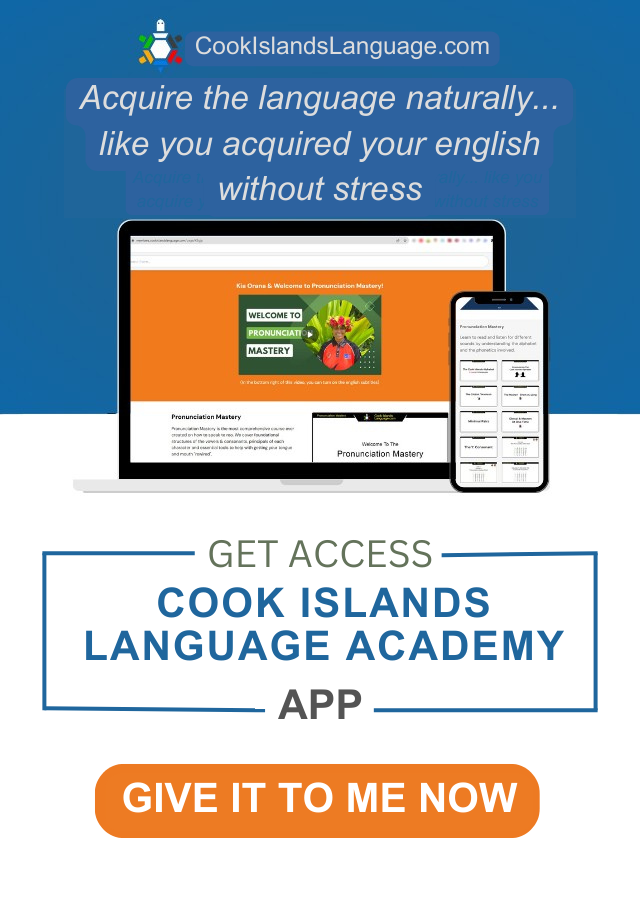
Making mistakes is part of the learning process, and the challenge of reading the Cook Islands Bible in the old King James version was worth it. The exercise stretched and contorted my mouth to no end but helped me overcome any fear of funny-sounding pronunciation. It helped to water down my strong brownie-kiwi accent. Reading and listening skills (in my case, I love listening to cookie music) are two of the skill sets that will give you massive gains and are lifesavers when you listen in when native speakers prattle on. You don't have to get every word right-as long as you get a vague understanding of the messages being exchanged. Where before you were in complete darkness, you now have a bit of "light". We have a solid 8 videos, 2 hour free course on mastering pronunciation. It is the first step my wife made me do. She said i sounded like a "duck". Donald Duck.
Secret#6–Adults Learn Faster Than Kids
Research has shown that adults can be better language learners than children under the right circumstances. Age is not the limiting factor; it's the approach to learning that often holds us back. And it's making use of downtime that you can employ and turn into productive time that can compensate for not having enough time, eg like when you're out on your walks, at the gym, or even on the toilet. Use an app to take stuff in. 5 minutes here. 3 minutes there. 5 minutes there. It all adds up.
Secret#7 – Expand Your Vocabulary with Mnemonics
Instead of rote repetition, use mnemonics to remember words. Create memorable associations or stories for the words you're learning to make them stick in your memory. For example, I had a problem remembering the word "pa'ra'ara'a" which means "flat". As soon as I put a picture of a flat-roof building next to the picture of the island Rakahanga (where my wife comes from), I made the connection between my wife's flat island (Rakahanga)and a flat roofing iron house (para'ara'a). The words sound the same, the pictures look the same (flat island & flat roof) and every time i needed to think of the word "flat", my mind saw a picture of Rakahanga first, the sounding editors played in my head (Rakahanga/pakahanga/para'ara'a!) and out pops para'ara'a from my mouth. Te marama nei koe? (Do you understand?).
Secret#8 – Embrace Mistakes
Don't fear making mistakes; they are a vital part of the learning process. Making errors is an opportunity for growth. I always figure if I'm not making at least 10–20 booboos a day, then I am not growing. To challenge myself, I would always look for opportunities to speak in the reo at public functions. Putting my back up against the wall motivated me to practice, drill, and rehearse. Then, after my speech, my wife would help me analyze, note down, and practice on my areas to improve (mistakes). Embrace mistakes as part of the process, and you will get better every time you speak the language. It's like cutting down a tall oak tree (fear). I found the best way to do that is by taking action and doing it. No mistake was ever wasted.
Secret#9 – Create SMART Goals
Finally, define specific, measurable, attainable, relevant, and time-bound goals for your language learning. Short-term goals within a few months can keep you motivated and on track. You can measure your results and track your real-deal progress. If it's not measured, it isn't real. Hence the 3-month blocks, then time-out.
Be intentional. If you want to speak and use the language in 3 months, you can, if you apply the right inputting strategies. Reading, listening, singing, mimicking, and focusing on one topic that interests you. That is what i did. Its so much easier to narrow things down and focus on one topic rather than open-wide and try and be a dictionary. Interesting to note that Mormon missionaries, who are trained to learn another language to do their mission, do this. And so can you. If you plan on a longer time frame, like 2 years, that's easily achievable as well. It's up to you.
Conclusion.
In summary, these 9 Secrets are what I did to pick up the language, and they can also work for you. Remember, learning the Cook Islands language is a second language for you. As such, it is a gradual process, you "acquire it" or pick it up over time by being exposed do different things. Every step forward is an achievement. Enjoy it. It will transform your life.
See you in Rarotonga,
Tairi
PS. Here's a summary of the main points in steps:
Step 1: Mindset- Believe that language learning is possible. Your mindset is crucial for success.
Step 2: Learn the Right Words, the Right Way- Focus on words you'll use frequently. Avoid memorizing unnecessary vocabulary.
Step 3: Brainscape It- Use spaced repetition systems, like Brainscape, for effective learning.
Step 4: Speak Daily, from Anywhere in the World- Use technology to immerse yourself in the language. Listen to radio, watch television, and read content in the Cook Islands language online.
Step 5: Master Pronounciation- Start by mastering pronunciation. Take our free course.
Step 6: Adults Learn Faster than Kids- Research suggests that adults can be better language learners. Age is not the limiting factor; it's the approach to learning that matters.
Step 7: Expand Your Vocabulary with Mnemonics-Use memorable associations or stories to remember words effectively.
Step 8: Embrace Mistakes- Making mistakes is an opportunity for growth. Don't fear errors; they are part of the learning process.
Step 9: Create SMART Goals-Set measurable goals. Short-term goals within a few months can help keep you motivated and on track.
Incorporate these steps into your Cook Islands language learning journey, and you'll be well on your way to being a fluent speaker of the reo. Amene.
P.s.s.
Let me know in the comments section how you feel about picking up our lingo. What challenges you have. And any other thing that you may want to know. Cheers
Go here to start your journey:

Copyright @ CookIslandsLanguage 2023
Cook Islands Language Academy
www.CookIslandsLanguage.com
Rarotonga-Cook Islands | +682 74289
Auckland Office: New Zealand | +64275125727
Newsletter
Subscribe now to get daily updates.
Copyright @ CookIslandsLanguage 2023
Cook Islands Language Academy
www.CookIslandsLanguage.com
Rarotonga-Cook Islands | +682 74289
Auckland Office: New Zealand | +64275125727
Newsletter
Subscribe now to get daily updates.